|
Interview with Balduin
Intro:
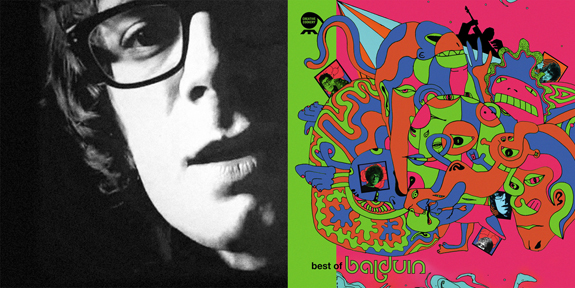
EC: On your website, it says "Balduin - Swiss Alchemist of Music since 1988". An alchemist is someone who transforms substances in something new and better. In what way do you transform music? Balduin: My music has ingredients of sun and darkness. Like in life, both elements need to be mixed to create a living substance. As a musical alchemist, I try to transform these opposites (joy and sadness, light and shadow) into songs that reflect our bittersweet and melancholic human experience. But actually, music in general is already a kind of its own alchemy by itself. EC: Is this Balduin the same as Claudio Gianfreda? Or why did you choose a pseudonym? Balduin: I try not to mix my artistic life too much with my private life, even though I can't somehow separate them completely. I felt that my music was too psychedelic to be represented by my everyday civil name. Balduin is more an artistic identity that exists in a different dimension and also allows me to express a different side of myself. EC: Your music is very much influenced by the 1960s, a time when a strong peace movement was active. Do we need to reflect on this time again? Balduin: I really think so, yes. We've forgotten what people are capable of when they connect through art, music and love. The Sixties carried a belief that music could break barriers and bring people together. We need a little more of that spirit today: making peace, and maybe even making love, through music. EC: What is so fascinating about the '60s? Balduin: It was a unique and brief golden period when everything seemed possible. Many genres blended into something entirely new, and artists were constantly experimenting. That creative freedom shaped a new sound that continues to influence musicians even today. EC: Robert Pally: The world is in a mess right now. What would you change to make it better? Balduin: I think we need to listen to each other more and be less afraid of our differences. Many of the problems we face come from division and misunderstanding. A little more empathy, curiosity and humanity would already make a big difference. EC: Can music help in difficult times? Balduin: Of course. Music has the power to heal and help us process emotions, find hope and feel less alone. For me, it has always been one of the best forms of therapy. EC: Your first two albums Creative Cookery and Same offer a mixture of acid jazz, space age, experiment, downtempo, bossa nova, beats and more. Your third album Rainbow Tapes (2009) sounds completely different. Why this musical direction change? Balduin: Rainbow Tapes was actually a compilation of songs I had recorded on tape many years before Creative Cookery and Same. My roots have always been in the psychedelic sounds of the Sixties. Those first two albums were something quite different. At the time, I was deeply into instrumental, sample-based downtempo music and fascinated by the new recording possibilities that computers were opening up. EC: Rainbow Tapes sounds like a mixture of The Beatles, Blossom Toes, The Legendary Pink Dots, Napoleon XIV, The Dukes of Stratosphere and at times, The Residents. Which bands do influence you? Balduin: At that time, I really only knew The Beatles, The Hollies, The Small Faces, The Stones or The Moody Blues. All the other bands I discovered much later. EC: Your fourth album Musical Images for Harpsichord was a homage to the Harpsichord. What triggered that? Balduin: The harpsichord was my dream instrument from the very beginning. I remember listening to Mozart and Scarlatti on the harpsichord when I was around ten years old and being completely fascinated by its sound. Later, I loved the way The Beatles and many other bands incorporated it into their music. I think it's a very special instrument that makes everything shine. Many people today consider it old-fashioned or quirky, but to me, it has a unique richness and character that no other instrument can quite replace. EC: You are a multi-instrumentalist. How many and what instruments do you play? Balduin: I'm a curious musician rather than a specialist, and I enjoy experimenting with many different instruments. Over the years, I've learned to play a bit of almost everything. The guitar and the Mellotron are the instruments I return to most often. EC: Why did you decide to be a one-man band? As a one-man band, how do you work in the studio? Balduin: I played in bands before, but eventually I realized that I was doing most of the writing and arranging myself. Often, the other members weren't interested in exploring the same musical ideas as deeply as I was. In the studio, I'm very much a control freak and I prefer to handle most things myself. It allows me to shape the music exactly as I imagine it. EC: Do you come from a musical family? Balduin: Not really. My mother played a little piano, and my father was always whistling around the house, but there wasn't a strong musical tradition in the family. EC: What made you want to become a musician? Balduin: I think the biggest trigger was watching the animation movie Yellow Submarine by The Beatles. I was fascinated by the plot and their music and wanted to learn how to play all those songs, so I picked up the guitar and started teaching myself. EC: What was the first song you wrote? Balduin: I honestly can't remember the first song I wrote. My brother had Yamaha and Casio keyboards with automatic accompaniment features, and I spent countless hours experimenting with them. I was always singing and improvising melodies: at home, in my parents' car, everywhere. Even before writing proper songs, I was constantly making music out of whatever was around me. EC: Which of your songs are you most proud of? Balduin: I think my favourite song I've ever written is "Leave To Seek The Light" from the album Bohemian Garden. Everything just came together perfectly: the lyrics, the melodies, the atmosphere. That doesn't happen every time. EC: Can you shed some light on your songwriting process? Balduin: My singer-songwriter songs mostly come to life by strumming random chords on the guitar, or when I start singing or whistling a melody during a stroll and record it on my phone. Usually, I record the guitar first and overdub all the other instruments later. The lyrics mostly come at the end, although I have also written some beforehand during my holidays. For example, I wrote "Waves, Stars & Moon" during a trip to Tunisia while gazing at the beautiful night sky. EC: What instruments do you use to create your sound? Balduin: That depends on the kind of sound and atmosphere I want to achieve. On my neo-psychedelic albums, I tried to use authentic analogue instruments such as real drums, tabla, sitar, tanpura, guitar, bass, vibraphone, xylophone, organ, Mellotron, and harpsichord. However, on a later album titled She's The One, I experimented with combining my songs with the deliberately cheesy digital sounds of 1980s equipment, such as the Yamaha DX7, a LinnDrum drum machine, and the Casio CZ-1. EC: Which of your albums is your favourite one and why? Balduin: I think All In A Dream is probably my strongest album, even if it might be a little too long. I was going through a very creative period in my life, but also some difficult times. For example, my father passed away. That experience, along with other personal changes, had a strong impact on me and inspired a lot of the music on the album. EC: What elements must a good pop song have for you? Balduin: A melody that never becomes boring, something catchy but also slightly obscure and unexpected. I appreciate diversity, honesty in both performance and recording, clever lyrics, and music that reveals new details every time you listen to it. EC: Which musician, living or dead, would you like to work with and why? Balduin: If I could choose only one, it would be Brian Wilson from The Beach Boys. I feel a strong connection to the way he works. Like me, he was deeply involved in every aspect of the creative process, and I also relate to his sensitivity as an artist. EC: You did a recent covers album with tracks by The Troggs, The Kinks, Manfred Mann and many pretty unknown bands. How did you pick the songs? Balduin: Recording cover versions is always a good exercise for songwriting. The songs I choose are usually the ones I keep returning to as a listener. Learning and recording them feels like a journey of discovery, where I gain a deeper understanding of how they were written. EC: How did you decide the running order of your last album Best of Balduin? Balduin: I felt it was the right time to collect some of the strongest tracks from the albums I've released over the years. Of course, it doesn't represent everything I've done, but it offers a good overview of my work. For new listeners, it's also an easier way to discover my music. EC: Which albums would you like to take on a lonely island? Balduin: The Blossom Toes We Are Ever So Clean, The Zombies Odessey And Oracle, The Pretty Things S.F. Sorrow, The Hollies Butterfly, The Beach Boys Friends, The Beatles Sgt. Pepper's Lonely Hearts Club Band... EC: How come your albums (Rainbow Tapes, Look At Me I'm You, All In A Dream, Bohemian Garden) landed on Sunstone Records (UK) and Sugarbush Records (UK)? Balduin: Sunstone Records contacted me after hearing my cover of "Jabberwock" by Boeing Duveen and The Beautiful Soup, which I had uploaded to SoundCloud and shared on Facebook. After they released Bohemian Garden, Sugarbush Records approached me about releasing Look At Me I'm You. Unfortunately, Sunstone Records stopped releasing new music shortly afterwards. EC: You are not playing live very often. Why? Balduin: I'm quite shy and don't enjoy being in the spotlight too much. I have trouble memorising my own lyrics, and I still get stage fright. Since I don't perform regularly, I would need a lot more practice to feel truly comfortable on stage. EC: How would you like to end your musical career? Balduin: To be honest, I hope I never have to. But as I get older, it takes more time and energy to find new ideas and create new material. For me, music is like a miracle: it appears when you least expect it, and sometimes disappears just as quickly. Discography:
MC5:
 |